Nurse English Competency Under Scrutiny After NHS Ban Over Patient Safety Failures
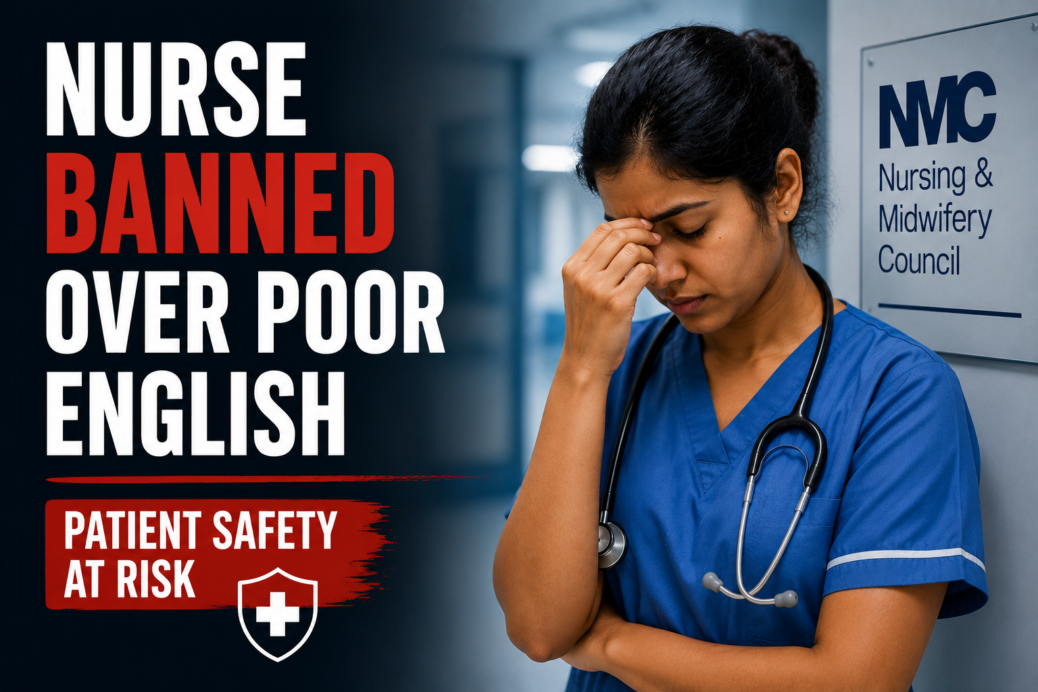
A nurse has been banned from working in the UK after serious concerns about her English language ability and clinical judgment were found to pose a risk to patient safety.
The case is reigniting an important conversation in nursing:
How important is English competency in healthcare?
According to reports, Animol Puthanpurackal Thomas was removed from the Nursing and Midwifery Council (NMC) register after multiple incidents at Broomfield Hospital in Essex revealed significant communication difficulties and unsafe practice. She worked as a supernumerary nurse at the hospital between August 2021 and May 2022.
And for many nurses — especially foreign-trained nurses — this story highlights a truth many already know:
English is not just a requirement. It is a safety tool.
Why This Nurse Was Banned
The NMC report found that Thomas had poor understanding of English, which affected her ability to communicate and safely care for patients.
One of the most serious incidents happened in February 2022.
While cleaning a patient, the report says she failed to recognise that the patient was having a seizure.
Worse, she did not pull the emergency alarm.
That moment alone could have had devastating consequences.
Seizures are medical emergencies.
Fast action matters.
Recognising deterioration is one of the most basic expectations in nursing.
And failing to respond can put lives at risk.
The panel also heard that this was not an isolated concern.
There were multiple incidents linked to communication struggles.
That pattern ultimately led to her being struck off.
Why English Competency Matters in Nursing
This case should be a wake-up call.
Because nursing is built on communication.
Every shift requires nurses to:
- understand clinical instructions
- respond quickly in emergencies
- communicate patient changes
- hand over safely
- educate families
- document accurately
Without strong English comprehension, patient care can suffer.
This is why countries like the UK require international nurses to pass exams such as:
- IELTS
- OET
- CBT
- OSCE
These are not “extra hurdles.”
They exist to protect patients.
And this case shows exactly why.
Foreign Nurses Face Strict English Rules for a Reason
For international nurses, passing English exams is one of the first and hardest steps.
Before many are even allowed to work, they must prove they can:
- speak clearly
- understand medical terminology
- respond in emergencies
- communicate safely with multidisciplinary teams
This process is expensive.
Stressful.
And often repeated multiple times.
Many nurses spend thousands doing it.
That’s why stories like this matter.
Because they remind everyone why the standard exists.
Who Allowed Her Through?
This is the difficult question.
If English competency is a core requirement:
how did she enter practice in the first place?
This is where accountability matters.
Was the assessment process strong enough?
Were concerns identified too late?
Was adequate supervision in place?
Because once a nurse is on the floor, patients assume the checks have already been done.
That trust is everything.
And if that trust breaks, the whole system is questioned.
Why This Matters for Honest International Nurses
This story can be frustrating for many foreign-trained nurses.
Because most work incredibly hard to meet these standards.
They:
- study for months
- repeat English exams
- pass competency tests
- complete adaptation programmes
And they do it properly.
So when cases like this happen, it can unfairly increase scrutiny on all international nurses.
That is the painful reality.
But it’s important to separate one individual case from the wider profession.
The majority of international nurses are safe, competent, and highly skilled.
Patient Safety Must Always Come First
At the centre of this story is one simple truth:
Patient safety cannot be compromised.
Not for staffing shortages.
Not for recruitment targets.
Not for convenience.
A nurse must be able to recognise emergencies.
Communicate effectively.
And act fast.
That is non-negotiable.
Final Thoughts
The banning of Animol Puthanpurackal Thomas is not just about one nurse.
It’s about the standards that protect patients.
It’s about why English competency matters.
And it’s about making sure systems are strong enough to identify risk before harm happens.
For international nurses, let this be a reminder:
Your English exam is not just a box to tick.
It is part of what makes you safe to practise.
And in nursing, safety must always come first.