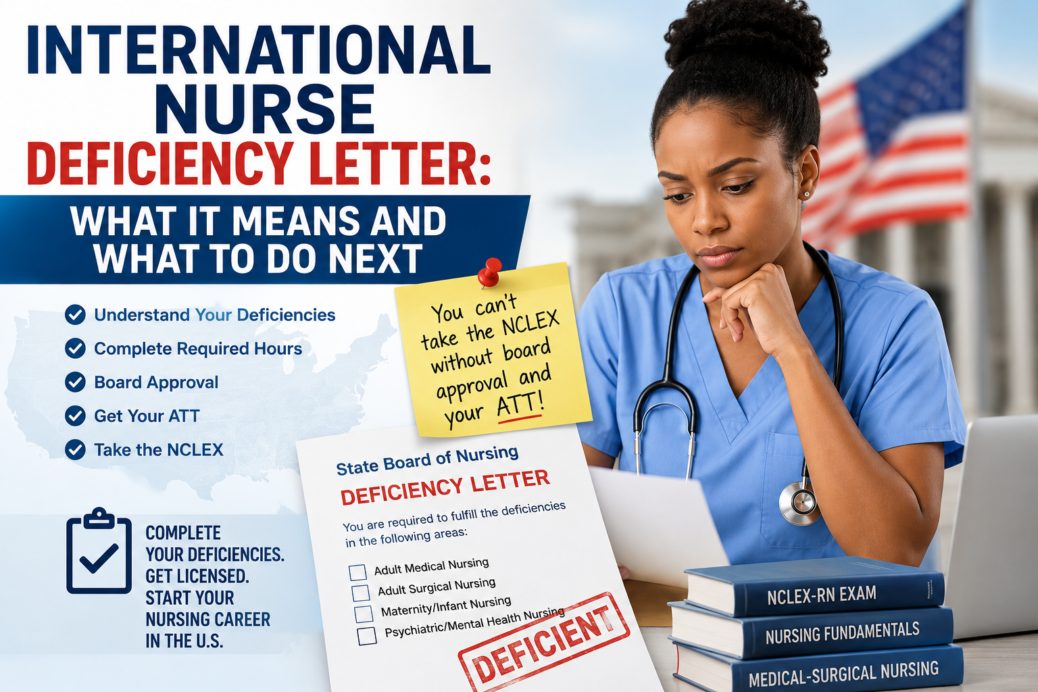
International Nurse Deficiency Letter: What It Means and What to Do Next
For many international nurses, getting to the United States and starting the nursing licensure process feels like the final stretch of a long journey.
You’ve paid for credential evaluations. You’ve submitted transcripts. You’ve sent documents back and forth. You’ve waited months.
Then the letter arrives.
And instead of approval, the board tells you your education is deficient.
This is one of the most frustrating moments many foreign-trained nurses face.
I know because I’ve been there.
If you have received a nursing deficiency letter from a U.S. Board of Nursing, do not panic. This does not always mean the end of your journey. But it does mean you cannot move forward until the deficiencies are resolved.
And this part is important:
You cannot receive your Authorization to Test (ATT) and you cannot sit for the NCLEX until the Board clears your deficiencies.
This is where many international nurses get stuck.
What Is a Nursing Deficiency Letter?
A deficiency letter is an official notice from the Board of Nursing stating that your nursing education abroad does not fully meet that state’s educational requirements.
This usually happens after the Board reviews your credential evaluation from organizations like CGFNS.
In simple terms, the Board is saying:
“Your training is recognised, but it is incomplete based on our standards.”
That means they have found gaps in your nursing theory or clinical hours.
For example, in one deficiency letter reviewed by the New Jersey Board of Nursing, the applicant was found deficient in multiple areas including:
- Adult Medical Nursing clinical hours
- Adult Surgical theory and clinical hours
- Maternity/Infant clinical hours
- Psychiatric/Mental Health clinical hours
This is common.
Why Do International Nurses Get Deficiencies?
The U.S. nursing education system is structured differently from many countries.
Common reasons include:
1. Lack of Concurrent Theory and Clinicals
This is one of the biggest reasons.
Many U.S. Boards require that theory and clinical practice happen at the same time.
For example:
If you studied maternity in January but completed maternity clinicals six months later, some Boards may reject it.
This is a huge issue for nurses trained in the UK, Ghana, India, Nigeria, and the Philippines.
2. Missing Clinical Hours
The Board may decide you do not have enough hours in:
- Adult Medical
- Surgical
- Paediatrics
- Maternity
- Psychiatric Nursing
Even experienced nurses can still be deficient.
Years of experience do not replace educational requirements.
3. Specialty-Based Training Abroad
Some international nursing programmes focus heavily on certain specialties but lack balanced rotations.
This creates gaps.
4. Different Educational Models
What is accepted in your country may not align with U.S. state laws.
And unfortunately, the Board’s decision is what matters.
What Happens After You Get the Letter?
This is where many nurses feel lost.
Once you receive a deficiency letter:
Your application is basically paused.
It does not move forward.
The Board will wait for proof that you completed the required theory and/or clinical hours.
Only after they accept this can they approve you for NCLEX eligibility.
That approval leads to your ATT.
Without ATT, you cannot book the NCLEX.
No ATT = No NCLEX = No license.
This is why resolving deficiencies quickly matters.
How Do You Complete Nursing Deficiencies?
This is the hardest part.
The Board usually requires your deficiencies to be completed under a qualified nursing faculty or clinical instructor.
For example, the New Jersey Board specifically states that instructors must meet strict faculty qualification standards and provide notarised proof of completion including:
- Full name and credentials
- Number of theory and clinical hours completed
- Start and end dates
- Name and address of the clinical facility
That means you cannot just volunteer at a hospital or shadow another nurse.
It must be formal.
Options include:
RN Refresher Programmes
Some colleges offer these.
But be careful.
Not all refresher courses cover Board deficiencies.
Always confirm first.
University Nursing Programmes
Some schools may allow you to join specific clinical modules.
This is rare but possible.
Board-Approved Remediation Providers
Some states have approved individuals or companies.
This can be one of the fastest routes.
Overseas Completion
Some Boards may accept deficiencies completed abroad.
But always ask first.
Never assume.
The Biggest Challenges International Nurses Face
Let’s be honest.
This process is hard.
Common struggles include:
- Schools refusing to take foreign-trained nurses
- Long waiting lists
- No paediatric placements
- High tuition fees
- Lack of clear guidance
- Confusing Board communication
- Hospitals unwilling to host external clinicals
Many nurses spend thousands and still cannot find placement.
This is the hidden side nobody talks about.
Questions to Ask Before Paying for Any Programme
Before you spend money, ask:
Is this programme accepted by my Board?
Will it cover my exact deficient subjects?
Will I receive an official notarised certificate?
Will there be direct instructor supervision?
Will the instructor meet Board qualifications?
Can you provide maternity, psych, or paediatric placements?
How long will placement take?
This can save you thousands.
My Advice to International Nurses
Do not delay.
The longer you wait, the harder it can become.
Start calling:
- Nursing schools
- Community colleges
- Refresher programmes
- Board-approved remediation providers
- Clinical educators
Email your Board and get everything in writing.
Document every conversation.
Be persistent.
This process can feel isolating, but you are not alone.
Many international nurses are going through the same thing.
Final Thoughts
A deficiency letter is not a denial.
It is a detour.
But it can feel like one of the biggest roadblocks in your nursing journey.
The key is understanding this:
Your Board must clear you first before you can receive ATT.
Without Board approval, the NCLEX is not even an option.
That is why remediation is everything.
If you are in this process right now, keep going.
There is a way through.
It may take time.
It may take money.
It may take persistence.
But your nursing journey in America is not over.









[…] international nurses, receiving a deficiency letter from a U.S. Board of Nursing can feel confusing, stressful, and unfair. Many nurses have years of […]